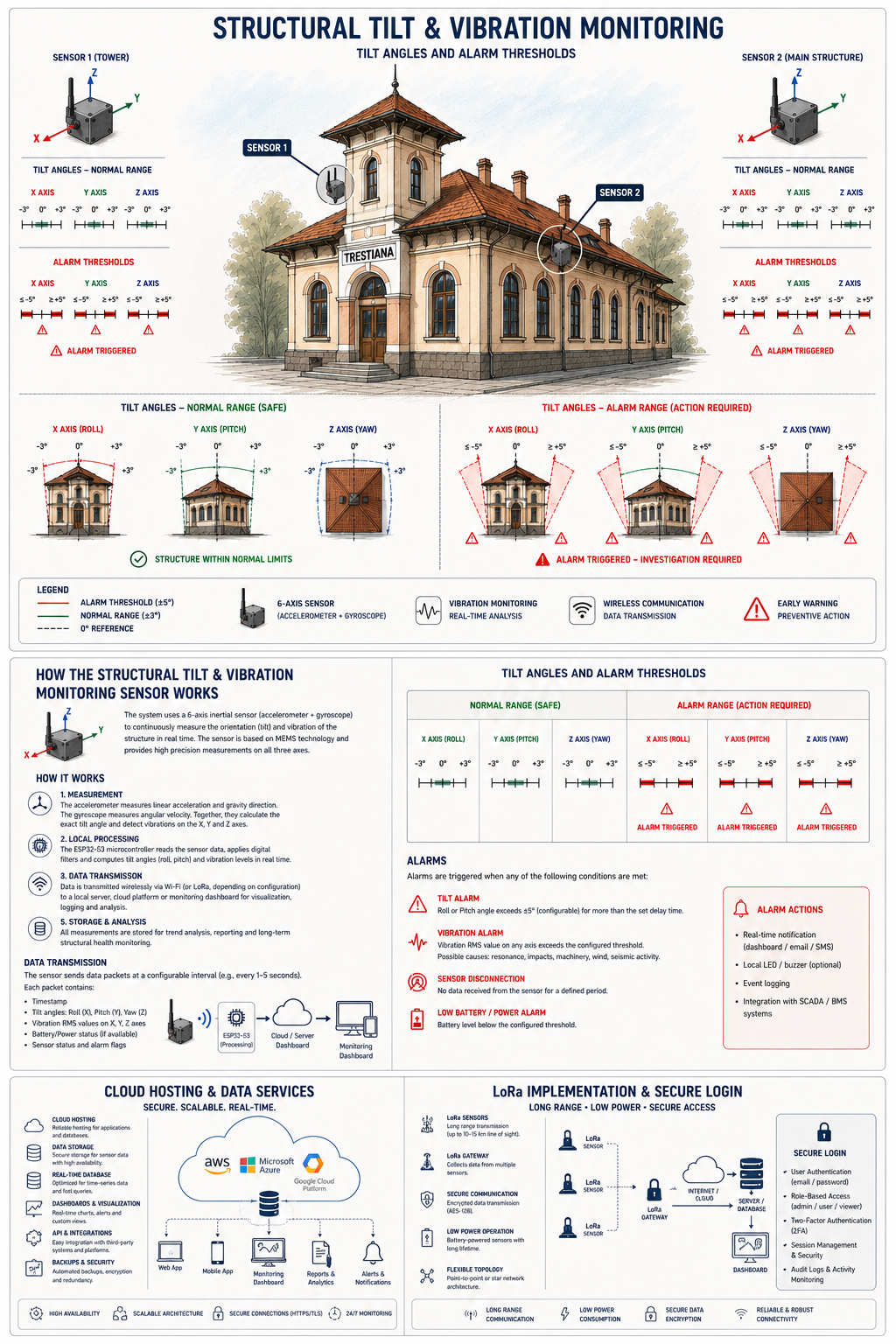
How the Structural Monitoring System Works
The structural tilt and vibration monitoring system is based on ESP32-S3 and 6-axis inertial sensors that combine an accelerometer and gyroscope in a single compact unit.
Each sensor is installed on a fixed point of the structure—such as a wall, steel beam, column, or foundation—and continuously measures movement on three axes (X, Y, Z).
Tilt Detection
The accelerometer measures the sensor’s orientation relative to gravity and calculates the inclination angle of the monitored structure:
X axis (Roll) – side-to-side inclination
Y axis (Pitch) – forward/backward inclination
Z axis (Yaw / rotational movement)
Normal values remain within predefined operating limits. Any deviation beyond the accepted range can indicate:
->structural displacement
->settlement or movement
->vibration transfer from equipment
->environmental stress (wind, impact, vibration)
Vibration Monitoring
The gyroscope detects movement speed and rotational changes in real time.
This allows the system to identify:
->continuous vibration from machinery
->abnormal oscillations
->sudden movement or impact
->repetitive vibration patterns that may indicate resonance or --mechanical stress.
Sensor readings are sampled continuously and filtered to remove short disturbances or temporary noise.
Data Transmission
Measured values are processed by the ESP32-S3 controller and transmitted wirelessly.
Depending on project requirements, data can be sent through:
->Wi-Fi
->local network infrastructure
->IoT dashboard integration
->cloud monitoring platforms